Internal Linking for Beginners: The 3-Link Formula That Works
Why Internal Links Matter More Than You Think
Most beginners treat internal links like a checkbox. Add them, move on.
That’s why their rankings plateau at position 15 and stay there. Internal links aren’t decoration. They’re how Google understands what your site is actually about, and they’re how authority flows from your homepage to the pages that need it most.
Here’s what you need to know: you don’t need a complex linking strategy. You need a pattern. One pattern that scales across hundreds of pages without overthinking it.
The 3-Link Formula
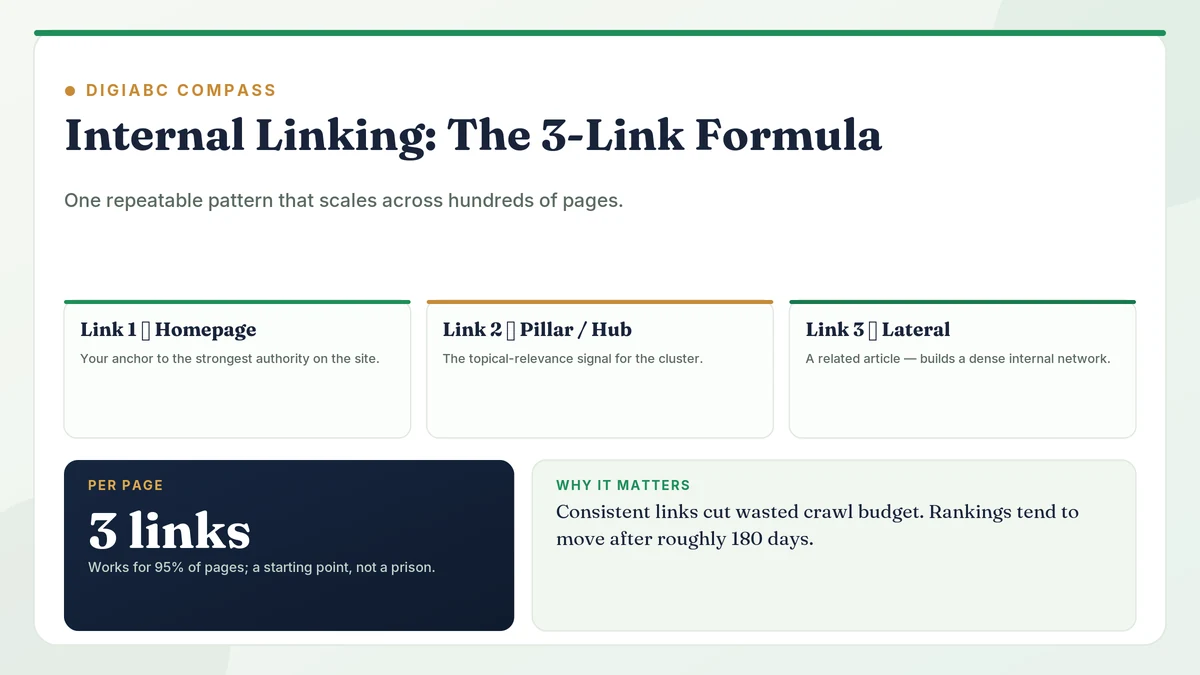
Give every page at least three internal links, placed deliberately. Google has never published a number, and there is no magic count. Three is a floor that is easy to remember and easy to keep, which is why it survives contact with a real publishing schedule. Here is where each one goes:
Link 1: To Your Homepage (or Core Pillar)
This is your anchor. It keeps every page connected to the strongest authority source on your site.
Link 2: To a Related Pillar/Cluster Hub
This is your topical relevance signal. It tells Google this page belongs to a specific topic cluster.
Link 3: To a Related Article (Lateral Link)
This is your internal cross-promotion. Lateral links create dense internal topical networks. They improve dwell time, reduce bounce rate, and signal to Google that your content is interconnected and comprehensive.
How to Actually Implement This
Step 1: Audit What You Have Now
Open Google Search Console. Export all your pages. Identify which pages have zero internal links pointing to them (orphan pages), which pages have 20+ links (signal dilution), and which pages are missing a link to your core pillar. This usually takes 30 minutes for a 100-page site.
Step 2: Fix the Gaps, Highest-Value Pages First
Work down the list in order of importance, not in order of how broken they are. Add the missing homepage or pillar link first, because that is what routes authority. Then add the lateral link to a genuinely related article, using anchor text that describes the destination rather than a generic click here. Do the ten pages that matter most before you touch the long tail.
When 3 Links Is Not Enough
The formula works for 95 percent of pages. Long-form content 3000+ words: add a 4th link if it makes sense. Cornerstone pages should link to 8 cluster pages, but keep under 10. Thin pages under 300 words: stick to 2 links. The formula is a starting point, not a prison.
Why This Works
Google’s crawlers have finite resources. They do not crawl your entire site every day. They crawl based on: Site crawl budget, Crawl depth, and Freshness signals.
When you keep internal links consistent and predictable, you reduce wasted crawl budget. Google crawls faster, indexes faster, and allocates resources to ranking. The 3-link formula is the sweet spot: useful, consistent, and scalable to 1000+ pages.
Action: Start Today
Pick your 10 most important pages. Audit them right now. Do they have: A link back to homepage? A link to topical pillar? A link to related article? If any page is missing one, add it today.
Then set a rule: no page publishes without the 3-link formula. Expect crawl activity to respond first, indexation next, and rankings last. On the sites I have done this on, the ordering has been consistent even when the timing was not, so treat it as a sequence rather than a schedule.

4 Comments