What Are Citations in SEO? Types, Examples and Top Sites
By Kavinder Singh | Last updated: 7 August 2026
A citation is a mention of your business’s name, address, and phone number on a website you don’t own. That’s it. No link required.
People confuse this with backlinks constantly, and the confusion leads them to build the wrong thing. A backlink passes authority. A citation passes verification. Different mechanism, different purpose, different sites.
I opened every directory in the list below on 7 August 2026 rather than copying it from another blog. Four came back healthy. One served me an empty page while every listicle on the internet insists it’s operational. One rebranded years ago and half the industry still uses the old name.
What is a citation in SEO?
A citation is any online mention of a business’s name, address, and phone number (NAP) on a third-party website. Citations can be structured, appearing in directory databases with fixed fields like Google Business Profile or Yelp, or unstructured, appearing inside prose on news sites, blogs, and event pages. Search engines cross-reference citations across independent sources to verify that a business exists and that its contact details are accurate.
Citation vs backlink vs listing
Three words, used interchangeably, meaning different things.
A backlink is a hyperlink from another site to yours. It can pass ranking signals. It says nothing about where your business is located.
A citation is a NAP mention. It may or may not include a link. Its job is corroboration, not authority transfer.
A listing is your profile on a specific platform. One listing produces one structured citation, plus possibly a link, plus possibly reviews.
A citation with no link still counts. That surprises people, and it’s the single most useful thing to understand about the topic.
Why citations work
Not because they’re “a ranking factor.” That phrase gets repeated so often it’s stopped meaning anything.
Google cannot verify your business exists by crawling your own website. Anything on your site is a self-claim, and self-claims have no evidentiary value. So Google cross-references your NAP against sources it didn’t get from you. Agreement across independent sources raises confidence. Disagreement — two spellings of your street, a stale phone number on an old profile — leaves Google with competing data and no way to adjudicate, so it discounts the lot.
Corroboration. That’s the entire mechanism, and once you see it, the strategy follows: consistency matters far more than volume.
Google’s local documentation names relevance, distance, and prominence as its three factors, and describes prominence as drawing on information about a business from across the web, including directories. That’s confirmed guidance.
The weight is not confirmed. You’ll find “citations account for 7% of local ranking signals” quoted as though someone measured it. That figure comes from Whitespark’s Local Search Ranking Factors report, which asks SEO practitioners for their opinions. It’s a sentiment survey, not an algorithmic measurement, and treating it as the latter is how bad strategy gets built.
Types of citations
By format
Structured citations live in a database with defined fields. Name here, street there, phone in its own box. Google Business Profile, Yelp, BBB. Machine-readable, easy to parse, easy to cross-check.
Unstructured citations appear inside running text. A local newspaper writes about your shop and includes the address. A blogger lists you in a roundup. A conference programme prints your details. Harder for search engines to extract, but generally more trusted, because you couldn’t submit them yourself.
Most people chase structured citations exclusively. Unstructured ones are harder to get and worth more.
By role
| Type | What it is | Examples |
|---|---|---|
| Core platforms | The map and search products people actually use | Google Business Profile, Bing Places, Apple Business Connect |
| Data aggregators | Feed NAP data downstream to many directories at once | Data Axle, Foursquare, TransUnion Digital Business Profile |
| General directories | Broad, any-industry business listings | Manta, Brownbook, Superpages, BBB |
| Vertical directories | Industry-specific, carry category relevance | TripAdvisor, Healthgrades, Avvo, Angi, Trustpilot |
| Geo / hyperlocal | City chambers, trade bodies, regional associations | Local chamber of commerce, industry associations |
| Unstructured mentions | NAP inside editorial content | News articles, blog roundups, event listings |
The aggregator layer
This is the part most citation guides skip, and it’s the reason US local SEO is easier than local SEO almost anywhere else.
Submit accurate data to an aggregator and it propagates into dozens of downstream directories automatically. You do the work once instead of forty times.
Three matter:
- Data Axle — phone-verifies records and distributes to search engines, in-car navigation systems, and library systems
- Foursquare — acquired Factual in 2020, supplies location data to Apple Maps, Uber, and Meta
- TransUnion Digital Business Profile — formerly Neustar Localeze, still operating at neustarlocaleze.biz
That last one is worth pausing on. Neustar Localeze was renamed to TransUnion Digital Business Profile, yet a large share of citation guides published in 2026 still call it Neustar Localeze with no note that the brand changed. If a guide hasn’t caught a rename this significant, assume it hasn’t checked anything else either.
I confirmed the rename through TransUnion’s own support and app pages. I have not independently measured propagation rates for any of the three, so treat “it feeds hundreds of directories” as vendor marketing until someone shows you the downstream list.
Outside the US, this layer mostly doesn’t exist. India has no clean equivalent, which changes the entire economics of citation building there — I wrote about that separately.
The verified list
Fetched directly on 7 August 2026. “Verified live” means the homepage served real content and exposed a working path to add or claim a business.
| Site | URL | Type | Free? | Status (7 Aug 2026) |
|---|---|---|---|---|
| Google Business Profile | business.google.com | Core | Yes | Do this first, nothing else is close |
| Bing Places for Business | bingplaces.com | Core | Yes | Feeds Bing and Copilot |
| Apple Business Connect | businessconnect.apple.com | Core | Yes | Apple Maps, iPhone default |
| Better Business Bureau | bbb.org | General / trust | Free listing, paid accreditation | Verified live |
| Manta | manta.com | General (US) | Yes | Verified live |
| Superpages | superpages.com | General (US) | Yes | Verified live — see duplicate warning |
| Brownbook | brownbook.net | General (global) | Yes | Verified live |
| Yelp | yelp.com | General / reviews | Yes | Could not fetch — bot protection |
| Chamber of Commerce | chamberofcommerce.com | General (US) | Yes | Could not fetch — no content returned |
| MerchantCircle | merchantcircle.com | General (US) | Yes | Could not fetch — no content returned |
| Citysearch | citysearch.com | General (US) | Unclear | Served an empty page — see below |
The Superpages trap
Superpages is live and healthy, running under Thryv with a 2026 copyright. But click Claim Your Listing and it redirects you to yellowpages.com.
They’re the same system. Counting Superpages and YellowPages as two separate citations is double-counting one submission. Most “70+ directories” lists include both as separate line items.
Citysearch
Every US citation listicle includes Citysearch. Wikipedia and several 2026 blog posts describe it as an operational city guide.
The homepage served me a Google Tag Manager iframe and a tracking pixel hosted on an eLocal domain. No search box, no listings, no navigation, no content. Citysearch is owned by CityGrid Media, an operating business of eLocal, which matches what I saw.
I’m not calling it dead, because I checked one page on one day and a rendering failure is possible. I am saying nobody recommending it has looked at it recently. Check it yourself before you spend twenty minutes on a submission.
Yelp, Chamber of Commerce, MerchantCircle
All three returned nothing to my fetch. For Yelp that’s almost certainly bot protection — it’s one of the largest review platforms in the world and there’s no reason to think it’s down. For the other two I have no read either way.
I won’t mark something verified that I couldn’t verify. Open them in a browser.
Vertical directories beat general ones
A general directory confirms your NAP. A vertical directory confirms your NAP and your category, and category relevance is the harder signal for Google to establish.
Restaurants and hotels — TripAdvisor, OpenTable. Healthcare — Healthgrades, Zocdoc. Legal — Avvo, Justia. Home services — Angi, Houzz, Thumbtack. Software — G2, Capterra. Any business with customers who leave reviews — Trustpilot.
I named these from established industry knowledge and did not fetch-verify them in this session. Open them before submitting. The whole point of this article is that lists get copied without checking, and I’m not going to do the thing I’m criticising.
Audit before you build
The instinct after reading an article like this is to go create thirty new listings. Usually the wrong move.
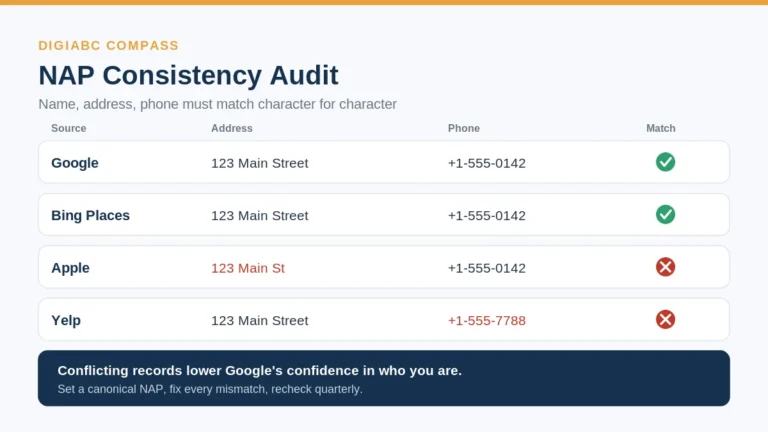
If your NAP already exists in four inconsistent versions across the web, a fifth source doesn’t clarify anything. It adds another data point to a conflict Google already can’t resolve. One phone number variation is enough to fragment how your business gets recognised as a single entity.
Search your business name in quotes. Search your current phone number. Search your previous phone number, and your previous address if you’ve moved. Write down every version that exists.
Fix the conflicts first. Cleanup beats acquisition, and it isn’t close.
What actually to do
Google Business Profile, Bing Places, Apple Business Connect. Under an hour combined, free, and they carry more distribution than everything else on this page put together.
Then audit for conflicts.
Then one aggregator if you’re in the US, because the propagation genuinely saves time.
Then your vertical directory — the one where your customers already look.
Then stop. Directory number thirty is not the thing standing between you and the map pack.
FAQs
Do citations still matter in 2026?
For entity verification, yes. For direct ranking lift from volume, much less than a decade ago. Mass submission stopped working years ago; consistency across a small authoritative set still does something.
Does a citation need a link?
No. The NAP mention alone functions as a citation. A link is a bonus.
How many citations do I need?
There’s no threshold, and anyone quoting a specific number is guessing. Ten accurate consistent listings outperform fifty inconsistent ones.
Are paid directory listings worth it?
Not for citation purposes — the free tier produces the NAP mention. Paid tiers buy leads and placement, which is a separate commercial decision.
Do data aggregators work outside the US?
Barely. The aggregator model is largely a US phenomenon. In most other markets, including India, submission is manual and directory-by-directory.
Should I hire a citation building service?
Only if they show you the exact directory list before you pay. Anyone selling “500 submissions” is selling volume on sites like the empty one above.
Key takeaways
- A citation is a NAP mention on a site you don’t own. The link is optional.
- The mechanism is corroboration, not authority transfer. That’s why consistency beats volume.
- Structured citations sit in directory databases; unstructured ones sit in editorial text and are worth more.
- The US aggregator layer is real and saves time. Most other markets don’t have one.
- Neustar Localeze is now TransUnion Digital Business Profile, and guides still using the old name haven’t been checked.
- At least one directory on every popular US list served an empty page when I opened it.
I re-check this list every six months and update the date at the top. Find something here that’s gone dark, tell me and I’ll pull it.
Verification method: Each directory marked “verified live” was fetched directly on 7 August 2026 and assessed on whether it served real content and exposed a working business-submission path. Sites marked “could not fetch” returned no usable content and are reported as unverified rather than dead. Ranking-factor weightings referenced above come from Whitespark’s Local Search Ranking Factors report, a practitioner opinion survey rather than an algorithmic measurement. The relevance/distance/prominence framework comes from Google Business Profile Help documentation. Aggregator ownership and rename details were confirmed via TransUnion and Foursquare’s own materials.