Slow Travel: Why Staying Longer Beats Collecting Cities
The instinct on a first big trip is to see everything. Ten cities in ten days, a new bed every night, a camera roll full of places you barely stood in. It looks efficient. It is mostly transit, and you remember almost none of it a year later.
Slow travel is an approach that favours fewer destinations and longer stays over fitting in as many places as possible. Instead of a city a day, you spend a week or more in one place, move less between stops, and spend more time living somewhere than photographing it.
The maths quietly favours slow
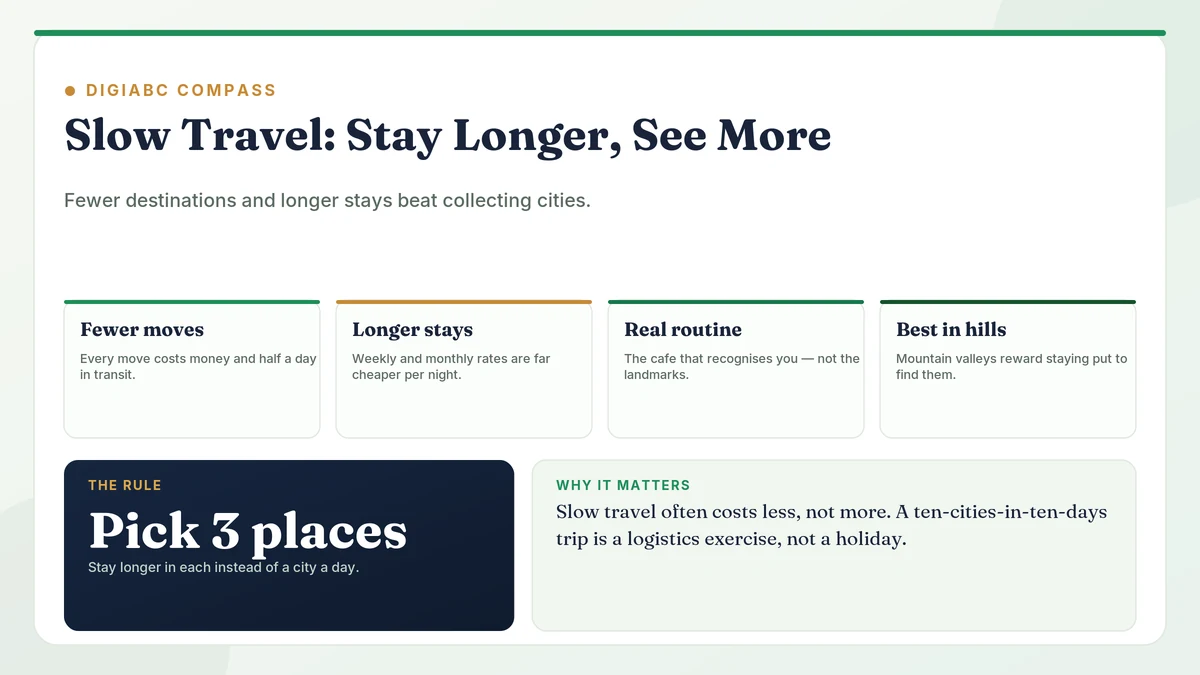
Every move costs money and a half-day: the checkout, the transfer, the checking-in somewhere new. Cut the number of moves and you cut both. Longer stays also get you weekly and monthly rates that are far cheaper per night than a string of two-night bookings, so slow travel often costs less, not more.
What you actually keep
The parts of a trip that stay with you are rarely the landmarks. They are the cafe where the owner started to recognise you, the walk you only found on day four, the routine you fell into. None of that happens when you leave before you have arrived. Staying longer is how a place stops being a backdrop and starts being a memory.
Where slow travel works best
Anywhere with depth rewards it, but mountains especially. A week in one valley beats racing through five. The hills in our Himachal Pradesh and Uttarakhand guides are a good example: the roads are slow by nature, the altitude asks for rest days, and the best parts are the ones you only reach by staying put long enough to find them.
One opinion, plainly: a ten-cities-in-ten-days trip is a logistics exercise, not a holiday. Pick three places, stay longer, and you will come home with more than tired feet and a full memory card.
FAQ
Is slow travel more expensive?
Usually less. Fewer moves mean fewer transfers and bookings, and longer stays get you weekly or monthly rates that are far cheaper per night than hopping between short stays.
How long is a “slow” stay?
There is no rule, but a few days to a week or more per place is the usual range, enough to settle into a routine rather than just passing through.
Written by Kavinder Singh. Last updated: August 3, 2026.