Core Web Vitals Explained: LCP, INP, and CLS
Core Web Vitals get more attention than they deserve and less understanding than they need. They are real, Google does use them, but they are a tie-breaker, not a foundation. Knowing what the three metrics actually measure stops you from either ignoring them or wasting weeks chasing a perfect score on a page that has bigger problems.
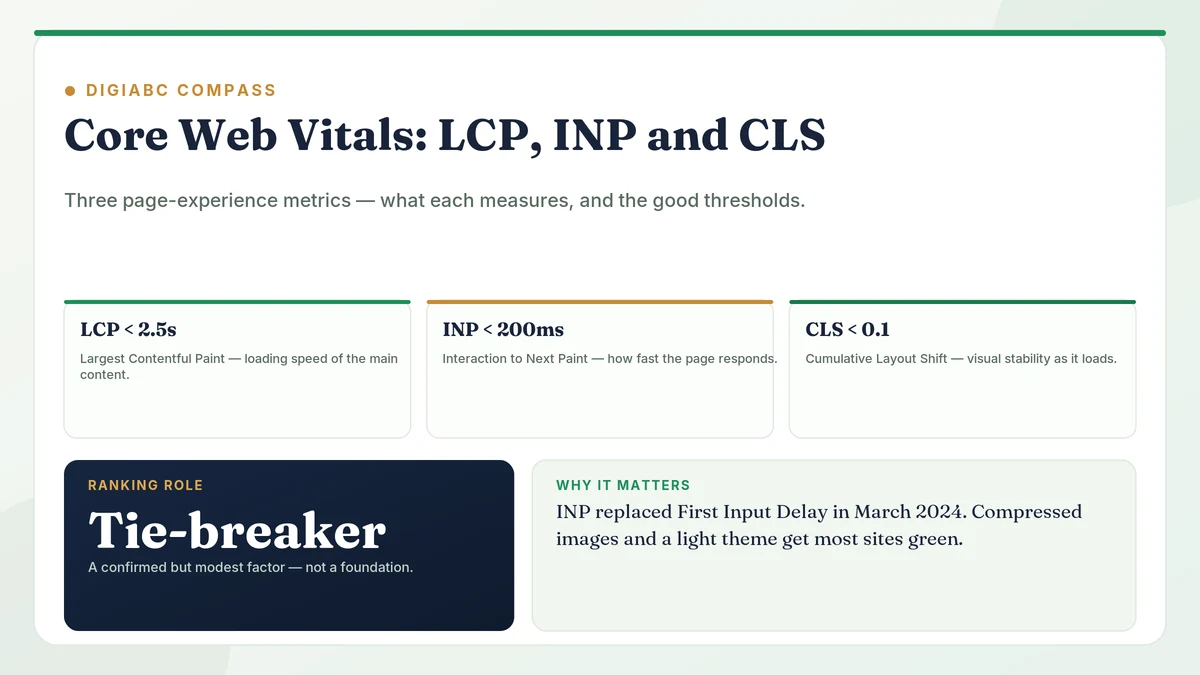
Core Web Vitals are three metrics Google uses to measure page experience. Largest Contentful Paint (LCP) measures loading speed, with good being under 2.5 seconds. Interaction to Next Paint (INP) measures responsiveness, good being under 200 milliseconds. Cumulative Layout Shift (CLS) measures visual stability, good being under 0.1.
What each metric measures
LCP is how long the main content takes to appear. A slow LCP usually comes from large images, slow hosting, or heavy themes. INP replaced the old First Input Delay in 2024 and measures how quickly the page responds when someone taps or clicks. CLS measures how much the layout jumps around as it loads, the annoyance of tapping a button that moves at the last second.
How to measure them
Two free tools cover it. PageSpeed Insights tests a single URL and gives both lab and real-world data with specific fixes. Google Search Console has a Core Web Vitals report that shows how your pages perform across real visits, grouped into good, needs improvement, and poor. Start with Search Console for the site-wide view, then use PageSpeed Insights to diagnose a specific page.
This sits inside the wider technical SEO work and supports the SEO guide.
The common fixes
Most wins are unglamorous. Compress and correctly size images, since they are the usual cause of slow LCP. Use a fast, lightweight theme and good hosting. Reserve space for images and ads so the layout does not shift, which fixes CLS. Reduce heavy scripts to improve INP.
One opinion: a clean theme and compressed images get most sites into the green without any deep engineering. If your site is thin or has no links, your time is better spent there than shaving milliseconds.
What “good” actually means
Google publishes thresholds for each metric, measured at the 75th percentile of real visits: Largest Contentful Paint (LCP) under 2.5 seconds, Interaction to Next Paint (INP) under 200 milliseconds, and Cumulative Layout Shift (CLS) under 0.1. The “needs improvement” and “poor” bands sit above those. INP replaced First Input Delay in March 2024 and is the stricter, more representative responsiveness metric.
Field data vs lab data
Two numbers exist for every metric and they are not interchangeable. Field data (the Chrome User Experience Report) reflects what real users experienced over the past 28 days and is what Google actually uses. Lab data (Lighthouse, PageSpeed Insights’ simulated run) is a controlled diagnostic that helps you debug but does not feed rankings. When they disagree, trust field data for impact and use lab data to find the cause.
How much it moves rankings
Be realistic: Core Web Vitals are part of Google’s page-experience signals, which are real but lightweight. They act as a tiebreaker between pages of similar relevance, not a substitute for matching intent and content quality. Fix them because they improve conversions and user experience first; the ranking effect is a bonus.
Fix in priority order
Start with the metric in the “poor” band on the templates that get the most traffic. LCP usually traces to a slow server response, render-blocking resources, or an unoptimised hero image; INP to heavy JavaScript on interaction; CLS to images and ads without reserved space. Fix the highest-traffic template first, because that is where the field data improves fastest.
FAQ
How much do Core Web Vitals affect rankings?
They are a confirmed but modest factor, strongest as a tie-breaker between pages of similar quality. Good content on a slightly slow page still beats a fast page with weak content.
What replaced First Input Delay?
Interaction to Next Paint (INP) replaced First Input Delay as a Core Web Vital in March 2024. It is a more complete measure of how responsive a page feels across all interactions, not just the first.
Written by Kavinder Singh. Last updated: August 3, 2026.

4 Comments
Comments are closed.