NAP Consistency and Citations: The Boring Local SEO Win Nobody Audits (2026)
NAP consistency is the least exciting task in local SEO, and it still matters more than most things you will spend money on. The reason it works is the reason nobody does it: it is tedious, repetitive, and invisible until it is wrong. That makes it one of the cheapest wins available, because almost no competitor bothers to audit it properly.
I have fixed a lot of these. The data is always scattered across a dozen platforms, each slightly off, and each small mismatch chips away at how confident Google feels about who the business is.
What is NAP consistency?
NAP consistency means your business name, address, and phone number appear identically across every place they are listed: your website, your Google Business Profile, and every directory. Identical means character for character. Google treats conflicting versions as a reason to trust your data less, and less trust means less visibility.
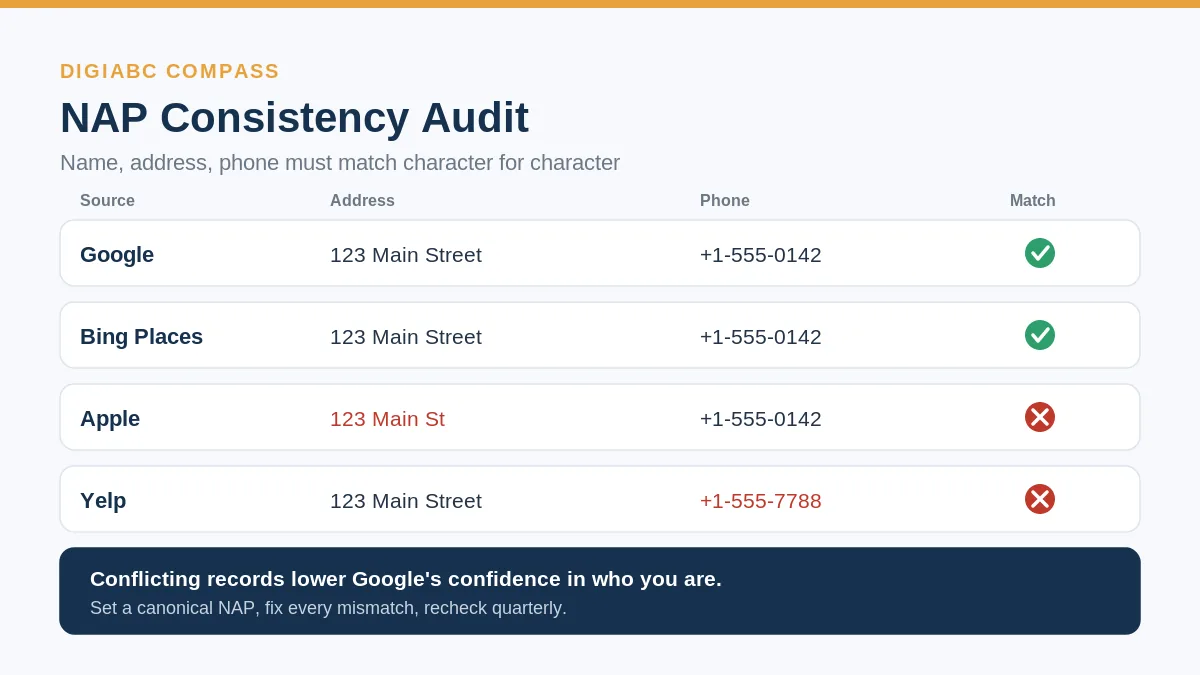
The acronym is simple. The discipline is not. “123 Main St” on one platform and “123 Main Street” on another is not a stylistic quirk to Google, it is a conflicting signal. Stack up enough of those and Google’s confidence about your address, and therefore your eligibility for nearby searches, quietly erodes. Where NAP fits among the other ranking factors is laid out in the local SEO guide.
What a citation actually is, and why it carries weight
A citation is any online mention of your business name, address, and phone, whether or not it links to your site. Structured citations live in directories like Yelp and Bing Places. Unstructured ones appear in articles, blog posts, and event pages. Together they corroborate your existence across the web.
Think of citations as votes of corroboration rather than votes of authority. Each consistent mention tells Google the same facts about your business, and agreement across many independent sources builds confidence. Whitespark’s 2026 survey weights citation signals lower than it once did, around 7% of local pack ranking, but the floor effect is real: inconsistent citations actively pull you down even when consistent ones add little.
That asymmetry is the whole point. You are not chasing citations to climb. You are cleaning them so they stop holding you back.
The platforms that actually matter
The core citation set is the handful of platforms Google cross-references most: Google Business Profile, Bing Places, Apple Business Connect, and the major data aggregators, plus the directories specific to your industry. Getting these right matters far more than volume across hundreds of low-quality directories.
Start with the ones that feed the ecosystem:
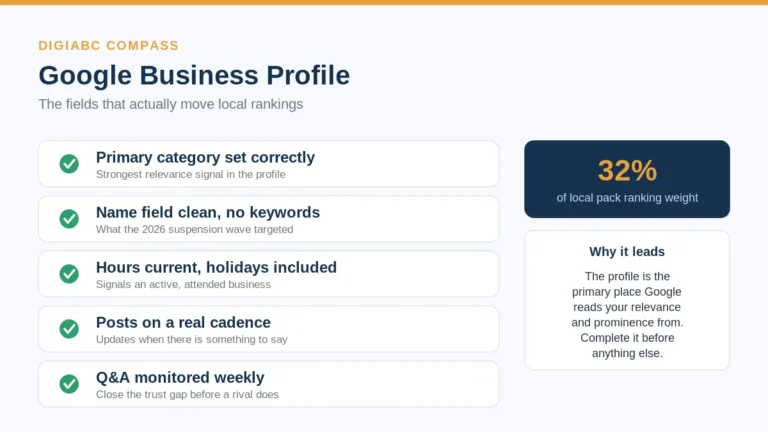
- Google Business Profile, the anchor everything else is checked against. Its setup is covered in the Google Business Profile guide.
- Bing Places and Apple Business Connect, which feed Bing and Apple Maps and are checked by their own systems.
- Yelp, which carries weight both as a directory and a review platform.
- Industry and local directories that genuinely apply to you, a contractor association, a regional chamber, a niche booking platform.
Skip the spammy submission services that blast you to five hundred directories. Those create more inconsistent records to manage later, not more visibility now.
How to run a NAP audit
A NAP audit is the process of pulling every listing for your business, lining the records up side by side, and correcting every mismatch in name, address, and phone. Done quarterly, it keeps your data clean as platforms auto-populate and customers create duplicate listings.
The process is mechanical, which is good, because mechanical means repeatable:
- Decide your canonical NAP. Write down the exact name, address, and phone, including abbreviations, suite format, and phone formatting. This is the single source of truth everything else gets matched to.
- Pull your listings. Search your business name and phone number, check the core platforms above, and note every version you find.
- Find the conflicts. Line them up. Flag every record that does not match the canonical version exactly.
- Fix and claim. Correct each one. Claim listings you do not control. Merge or remove duplicates, which are common after a move or a phone change.
- Recheck quarterly. Platforms refresh data on their own, and duplicates reappear. Once and never again does not hold.
The phone number deserves special care. A tracking number on one platform and your real line on another is one of the most common and most damaging mismatches, because the phone is a primary identifier Google uses to match records.
NAP and schema should tell the same story
Your structured data should restate the exact NAP that appears everywhere else. LocalBusiness schema gives Google a machine-readable version of your name, address, and phone, and when it matches your profile and citations, it reinforces the same entity rather than introducing a new variation.
This is where the tedious groundwork pays off. Once your canonical NAP is settled, it flows straight into your schema markup as the name, address, and telephone fields, with a sameAs link to your profile. The markup then corroborates everything else instead of adding a thirteenth slightly different version. The full setup is in the LocalBusiness schema guide.
What to do first
Settle your canonical NAP today, in writing. Then audit the four core platforms before touching anything else, because fixing your website while Bing and Apple still carry an old address leaves the conflict in place. Once the core set agrees, work outward to industry directories, and book a recurring quarterly reminder so the work never piles up again.
None of this is glamorous. It is also one of the few local SEO tasks where the effort is almost entirely uncontested, which is exactly why it returns more than its reputation suggests.
Frequently asked questions
Does a tiny address difference like “St” versus “Street” really matter?
It matters more than it should. Google treats the two as a conflicting signal rather than a synonym, and conflicts reduce confidence in your data. Pick one format and use it everywhere.
How many citations do I need?
Quality and consistency beat quantity. A clean core set on Google, Bing, Apple, Yelp, and your real industry directories outperforms hundreds of inconsistent listings from bulk submission services.
How often should I audit my NAP?
Quarterly. Platforms auto-populate data and customers create duplicate listings over time, so a clean audit drifts out of date within months if you never recheck it.
Should I use a call-tracking number on my listings?
Be careful. A tracking number that differs from your main line across platforms creates exactly the kind of phone mismatch that hurts. If you use tracking, keep it consistent and tie it to your real business identity.
Written by Kavinder Singh (Kavi), digital marketing strategist at DigiABC Compass. Last updated June 2026.