DigiABC · Digital Marketing
Learn the foundations. Explore a specific channel.
This collection covers SEO, content, email, analytics and AI in marketing. Read the guide below for an overview, or choose a topic to go deeper.
Digital marketing uses channels such as search, websites, email, social media and online advertising to reach an audience, support customer decisions and measure business outcomes.
This guide explains the main channels, how they work together, how to choose a starting point and what to measure. Start with your audience and objective before choosing tools or tactics.
Digital Marketing in Simple Words
Imagine opening a new coffee shop.
You could print thousands of flyers and hope the right people see them.
Or you could:
- Appear when someone searches “coffee shop near me”
- Show photos on Instagram
- Run Google Ads for local customers
- Send loyalty offers through email
- Encourage customers to leave Google reviews
- Publish blog posts about specialty coffee
- Answer customer questions through WhatsApp
- Be recommended by AI assistants when someone asks for the best cafés nearby
Every one of these activities is part of digital marketing.
Instead of waiting for customers to find you, digital marketing helps you meet potential customers wherever they spend their time online.
What Is the Goal of Digital Marketing?
Many people believe digital marketing is only about increasing website traffic.
Traffic alone does not grow a business.
The real goal is to help the right audience move from discovering your business to becoming loyal customers.
A successful digital marketing strategy typically aims to:
- Increase brand awareness
- Generate qualified leads
- Drive online and offline sales
- Build trust and credibility
- Educate potential customers
- Improve customer retention
- Increase lifetime customer value
- Create long-term business growth
Every campaign, blog article, advertisement, or social media post should support one or more of these objectives.
The Digital Marketing Ecosystem
Digital marketing works best when different channels support one another instead of operating independently.
| Digital Marketing | |||
| ▼ | |||
SEO | Paid Ads | Social Media | Content |
| ▼ ▼ ▼ ▼ | |||
| Website | |||
| ▼ | |||
| Lead Generation | Online Sales | ||
| ▼ ▼ | |||
| Email Marketing | |||
| ▼ | |||
| Customer Retention | |||
Businesses that integrate these channels typically achieve more consistent growth than those relying on a single marketing tactic.
Digital Marketing vs Traditional Marketing
Both traditional and digital marketing help businesses reach customers, but they operate differently.
| Feature | Traditional Marketing | Digital Marketing |
|---|---|---|
| Audience Targeting | Broad | Highly targeted |
| Cost | Usually higher | Flexible for most budgets |
| Performance Tracking | Limited | Real-time analytics |
| Personalization | Difficult | Highly personalized |
| Customer Interaction | Mostly one-way | Two-way communication |
| Speed | Slow to launch | Can launch within hours |
| Optimization | Difficult | Continuous improvement |
| Geographic Reach | Mostly local or regional | Local, national, or global |
Traditional marketing still has value for brand awareness and mass reach. However, digital marketing provides greater flexibility, better measurement, and more opportunities to optimize campaigns based on actual customer behavior.
Why Digital Marketing Matters in 2026
The way people discover businesses has changed dramatically.
A customer might:
- Ask ChatGPT for recommendations.
- Read Google AI Overviews.
- Compare reviews on Google Maps.
- Watch product reviews on YouTube.
- Browse Instagram before making a purchase.
- Visit your website multiple times before contacting you.
Customers rarely rely on a single channel.
Businesses that maintain a consistent presence across search engines, AI platforms, social media, and their own websites are more likely to earn trust and conversions.
Where AI Fits Into Digital Marketing
Artificial intelligence is changing how people search for information and how marketers deliver content.
Instead of typing short keywords, users increasingly ask complete questions such as:
- What is the best CRM for a small business?
- Which SEO strategy works for local businesses?
- How much should I spend on Google Ads?
AI-powered platforms often generate direct answers by combining information from multiple trusted sources.
This shift means businesses need content that is:
- Accurate and well-structured
- Easy for AI systems to understand
- Supported by clear definitions and examples
- Demonstrates real expertise and experience
- Organized into self-contained sections that answer specific questions
Rather than optimizing only for search rankings, businesses should aim to become reliable sources that both people and AI systems can reference.
Key Components of Digital Marketing
A complete digital marketing strategy typically includes several interconnected disciplines.
| Channel | Primary Purpose |
|---|---|
| Search Engine Optimization (SEO) | Increase organic visibility in search engines |
| Pay-Per-Click Advertising (PPC) | Generate immediate traffic through paid ads |
| Content Marketing | Educate audiences and build authority |
| Social Media Marketing | Increase awareness and engagement |
| Email Marketing | Nurture leads and retain customers |
| Local SEO | Improve visibility in location-based searches |
| Video Marketing | Demonstrate products and build trust |
| Influencer Marketing | Expand reach through trusted creators |
| Affiliate Marketing | Generate sales through referral partners |
| Marketing Automation | Improve efficiency and personalize customer journeys |
| Analytics and Measurement | Track performance and optimize campaigns |
Each channel serves a different purpose, but they are most effective when integrated into a single marketing strategy.
Key Takeaways
- Digital marketing is the process of attracting, engaging, converting, and retaining customers through digital channels.
- Successful strategies combine multiple channels rather than relying on a single platform.
- Search engines, AI assistants, social media, email, and websites all influence the modern customer journey.
- Businesses should optimize not only for search rankings but also for AI-generated answers and conversational search experiences.
- The most effective digital marketing focuses on solving customer problems, building trust, and measuring results over time.
How Digital Marketing Has Evolved (1990–2026)
Digital marketing has changed dramatically over the past three decades. What began with simple websites and banner advertisements has evolved into a sophisticated ecosystem powered by search engines, social media, artificial intelligence, automation, and real-time data.
In the early days, businesses only needed a website to establish an online presence. Today, customers discover brands through Google Search, AI assistants, YouTube, Instagram, email, online reviews, marketplaces, and messaging apps. They often interact with multiple channels before making a purchase.
Understanding this evolution helps explain why modern digital marketing is no longer about using a single platform. Successful businesses create consistent experiences across every stage of the customer journey while adapting to changing technologies and consumer behavior.
Digital Marketing Timeline
- Public internet becomes widely available
- Business websites emerge
- Banner advertising
- Email marketing begins
- Google becomes the leading search engine
- Google Ads launches
- SEO becomes mainstream
- Facebook and LinkedIn appear
- Smartphones become the primary device
- Mobile first experiences
- Instagram and YouTube grow rapidly
- Content marketing expands
- Marketing automation becomes common
- Artificial Intelligence
- AI powered search
- Google AI Overviews
- ChatGPT and conversational search
- Voice search
- Entity SEO
- Answer Engine Optimization (AEO)
- Generative Engine Optimization (GEO)
The 1990s: Building an Online Presence
The commercial internet became widely available during the 1990s, allowing businesses to create websites for the first time. Most websites acted as digital brochures, providing company information, contact details, and a list of products or services.
This decade also introduced banner advertising and email marketing. Businesses quickly realized they could reach people online at a lower cost than many traditional advertising channels.
Search engines such as Yahoo!, AltaVista, and later Google helped users discover websites, creating the foundation for what would eventually become search engine optimization (SEO).
What Changed?
- Businesses established an online presence.
- Websites became a new marketing channel.
- Email emerged as a scalable communication tool.
- Search engines made online discovery possible.
Key Focus: Visibility through websites.
The 2000s: Search Engines Changed Marketing
The 2000s marked one of the biggest turning points in digital marketing. As Google became the dominant search engine, businesses recognized that appearing in search results could generate a steady stream of potential customers.
SEO evolved into a dedicated marketing discipline focused on improving website visibility in organic search results. Around the same time, Google Ads introduced pay-per-click (PPC) advertising, giving businesses the ability to reach customers immediately by bidding on relevant keywords.
Social media also began to reshape online communication. Platforms such as LinkedIn and Facebook allowed businesses to engage directly with audiences instead of relying solely on traditional advertising.
What Changed?
- Search became the primary way people discovered businesses.
- SEO became a long-term growth strategy.
- Paid search provided immediate visibility.
- Social media introduced two-way communication.
Key Focus: Search visibility and measurable advertising.
The 2010s: Mobile, Content, and Social Media
The widespread adoption of smartphones transformed how people interacted with the internet. Instead of browsing mainly on desktop computers, users began searching, shopping, watching videos, and engaging with brands from their mobile devices.
At the same time, platforms such as Instagram, YouTube, Pinterest, and later TikTok became major discovery channels. Businesses invested heavily in creating educational content, videos, blogs, and social media posts to attract and retain audiences.
Google’s algorithm updates increasingly rewarded websites that provided helpful, relevant, and user-focused content rather than relying on outdated SEO tactics such as keyword stuffing.
Marketing automation also became more accessible, allowing businesses to personalize email campaigns, nurture leads, and improve customer relationships at scale.
What Changed?
- Mobile devices became the primary way people accessed the internet.
- Content marketing became essential for SEO.
- Video consumption increased rapidly.
- Social media became an important research platform before purchases.
- Personalization and automation improved customer experiences.
Key Focus: Content, engagement, and customer experience.
The 2020s: The AI-Powered Marketing Era
Today’s digital marketing landscape is driven by artificial intelligence, automation, and conversational search.
People increasingly ask complete questions instead of typing short keywords. Rather than searching for “CRM software,” someone might ask:
What is the best CRM for a small business with fewer than 20 employees?
Search engines and AI assistants now generate direct answers using information from multiple trusted sources. This means businesses are competing not only for search rankings but also for inclusion in AI-generated responses.
Modern digital marketing extends beyond traditional SEO. Businesses must create accurate, well-structured, and trustworthy content that both people and AI systems can understand.
At the same time, customer journeys have become more complex. A potential customer might:
- Ask an AI assistant for recommendations.
- Read Google AI Overviews.
- Compare reviews on Google Maps.
- Watch YouTube videos.
- Browse Instagram.
- Visit several websites.
- Return later through a remarketing campaign before making a purchase.
Every interaction contributes to the final decision.
What Changed?
- Artificial intelligence became part of marketing platforms.
- Search shifted toward conversational experiences.
- AI-generated answers reduced some traditional website clicks.
- Brand trust became more important than rankings alone.
- Businesses now optimize for both humans and AI systems.
Key Focus: Authority, trust, and multi-platform visibility.
How Customer Behavior Has Changed
Technology has changed how people make buying decisions.
Then (Early Internet)
Today
From Ranking to Being Recommended
For many years, digital marketing focused on achieving the highest possible rankings in search engines.
While rankings remain important, today’s goal is broader.
Businesses should aim to become trusted sources of information wherever customers search.
That includes:
- Google Search
- Google AI Overviews
- AI assistants
- YouTube
- Social media platforms
- Online reviews
- Industry publications
- Business directories
Visibility now depends on creating content that is useful, accurate, trustworthy, and easy for both people and AI systems to understand.
| Earlier Digital Marketing | Modern Digital Marketing |
|---|---|
| Website-focused | Customer journey-focused |
| Keyword optimization | Search intent and topical authority |
| Individual channels | Integrated multi-channel strategies |
| Desktop-first | Mobile-first and multi-device experiences |
| Broad advertising | Personalized experiences |
| Ranking in search engines | Visibility across search, AI, social media, and reviews |
| Limited analytics | Real-time measurement and optimization |
| Manual campaigns | AI-assisted automation |
2010s: Data, Mobile, and Content
The 2010s were about data and personalization. Companies got much better at tracking user behavior and using that data to show more relevant ads and content.
Instagram launched in 2010 and became a major marketing channel. Pinterest, Snapchat, and later TikTok followed.
Expert Insight
One of the most significant changes in digital marketing is that customers no longer rely on a single platform when researching a business. A person may discover a brand through an AI assistant, verify its reputation through reviews, watch videos on YouTube, visit the website, and return later through an email or remarketing campaign before making a purchase.
Businesses that understand this multi-touch journey are better positioned to build trust, improve conversions, and create sustainable long-term growth.
Key Takeaways
- Digital marketing has evolved from simple websites into a connected ecosystem of search engines, social media, AI, email, video, and automation.
- Each technological shift has changed how customers discover and evaluate businesses.
- Modern marketing is no longer about ranking on a single platform. It is about being visible wherever customers search for information.
- Artificial intelligence is reshaping search behavior, making clear, accurate, and well-structured content more valuable than ever.
- The businesses that succeed are those that combine strong technical foundations, helpful content, trusted brands, and consistent customer experiences across multiple channels.
How Digital Marketing Works
Digital marketing is not a collection of separate marketing channels.
Many people think digital marketing means running Google Ads, posting on Instagram, writing blog articles, or sending email campaigns.
These are individual tactics.
Digital marketing is a complete system that helps businesses attract potential customers, build trust, encourage action, and maintain long-term relationships. Every channel plays a different role, but they all work together to move people through the buying journey.
For example, someone may first discover your business through Google Search, watch a YouTube video explaining your service, read customer reviews, visit your website several times, subscribe to your email newsletter, and finally contact you weeks later. Each interaction contributes to the final decision.
Successful businesses do not rely on a single marketing channel. They build an ecosystem where every touchpoint supports the next step in the customer’s journey.
The Digital Marketing Process
Every successful campaign follows the same basic framework.
The Four Stages of Digital Marketing
Although businesses use different platforms and strategies, almost every marketing campaign supports one of four objectives.
| Stage | Goal | Common Channels |
|---|---|---|
| Attract | Help people discover your business | SEO, PPC, Social Media, YouTube, Local SEO |
| Engage | Educate visitors and build trust | Blog posts, videos, guides, FAQs, webinars |
| Convert | Encourage people to take action | Landing pages, forms, calls, product pages |
| Retain | Build long-term relationships | Email marketing, remarketing, loyalty programs, customer support |
Focusing only on attracting visitors often leads to disappointing results. Sustainable growth comes from improving every stage of the customer journey, not just increasing website traffic.
Understanding the Marketing Funnel
The marketing funnel describes how people move from discovering your business to becoming loyal customers.
Not every customer moves through these stages at the same speed. Some people make a purchase immediately, while others spend weeks or months comparing options before making a decision.
The role of digital marketing is to provide the right information at each stage, helping potential customers move forward with confidence.
Customer Journey vs Marketing Funnel
These terms are often used interchangeably, but they describe different concepts.
| Marketing Funnel | Customer Journey |
|---|---|
| Represents the business perspective | Represents the customer’s perspective |
| Focuses on conversions | Focuses on the overall experience |
| Often follows a structured path | May involve multiple channels and repeated interactions |
| Measures campaign performance | Measures customer behavior and satisfaction |
Understanding both helps businesses design marketing strategies that are effective and customer-focused.
The Core Components of Digital Marketing
Digital marketing is built on several interconnected components.
Visibility
Customers must be able to find your business through search engines, AI assistants, social media, local listings, or paid advertising.
Trust
Visitors need confidence that your business is reliable. Helpful content, reviews, testimonials, case studies, certifications, and transparent information all contribute to trust.
User Experience
A fast, mobile-friendly website with clear navigation, accessible content, and straightforward calls to action improves engagement and conversions.
Conversion
Every page should guide visitors toward a meaningful next step, whether that’s making a purchase, requesting a quote, booking an appointment, or subscribing to a newsletter.
Retention
The relationship doesn’t end after the first sale. Email campaigns, loyalty programs, educational resources, and responsive customer support encourage repeat business and long-term loyalty.
How Different Marketing Channels Work Together
Digital marketing channels are most effective when they support one another rather than operating independently.
For example:
- SEO attracts people actively searching for information.
- Paid advertising generates immediate visibility.
- Content marketing answers questions and builds trust.
- Email marketing nurtures leads who are not ready to buy.
- Remarketing reminds previous visitors about your business.
- Analytics helps improve every stage based on real performance data.
When these channels work together, businesses create a more consistent customer experience and improve overall marketing effectiveness.
How AI Has Changed the Customer Journey
Artificial intelligence has introduced a new discovery stage before users even visit a website.
A customer might now:
This means businesses must create content that is accurate, well-structured, and trustworthy enough to be referenced by both search engines and AI systems.
I recommend keeping this section concise on the pillar page. Each marketing type should explain what it is, how it works, when to use it, and why it matters in 200–350 words. Then, link to a dedicated guide for readers who want more detail.
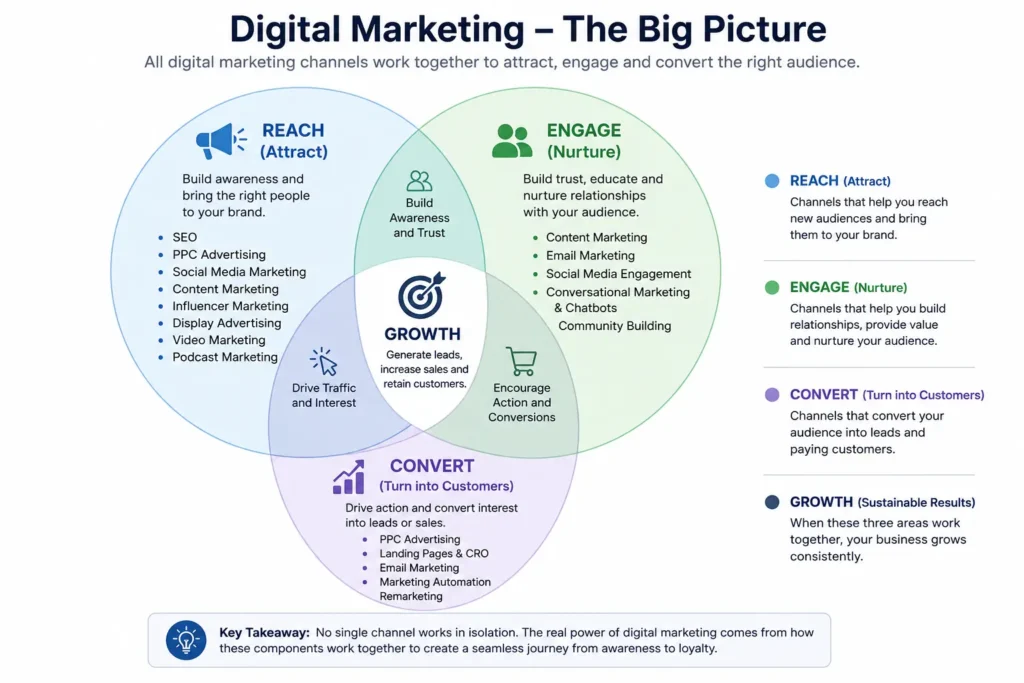
Types of Digital Marketing
Digital marketing is not a single strategy. It consists of multiple channels, each designed to achieve different business goals. Some channels help people discover your business, while others build trust, generate leads, or encourage repeat purchases.
The most effective digital marketing strategies combine several of these channels to create a consistent customer journey rather than relying on just one marketing method.
1. Search Engine Optimization (SEO)
Search Engine Optimization (SEO) is the process of improving a website’s visibility in organic search results on search engines such as Google and Bing. Instead of paying for every visitor, SEO helps businesses attract traffic by creating helpful content, improving technical performance, and building website authority.
For example, when someone searches “best digital marketing agency”, the websites that appear in the organic search results have typically invested in SEO.
SEO is a long-term strategy that focuses on understanding search intent, publishing valuable content, improving website performance, and earning trust from both users and search engines. While it usually takes time to deliver results, it can generate consistent, high-quality traffic for years.
Best for: Local businesses, e-commerce stores, SaaS companies, blogs, and service providers.
2. Pay Per Click (PPC) Advertising
Pay Per Click (PPC) advertising allows businesses to display advertisements on search engines and other platforms while paying only when someone clicks the ad.
Platforms such as Google Ads and Microsoft Advertising enable advertisers to target users based on keywords, location, interests, and demographics.
Unlike SEO, PPC can generate traffic almost immediately, making it useful for product launches, seasonal campaigns, and businesses that need quick results. However, traffic usually stops once the advertising budget is exhausted.
Best for: Immediate lead generation, product launches, and competitive markets.
3. Content Marketing
Content marketing focuses on creating valuable and informative content that helps potential customers solve problems, answer questions, or make better decisions.
Common content formats include blog posts, guides, videos, case studies, infographics, webinars, and downloadable resources.
Instead of directly selling a product or service, content marketing builds trust and positions a business as an authority in its industry. It also supports SEO by increasing the number of useful pages that search engines can index.
Best for: Building authority, supporting SEO, and educating customers.
4. Social Media Marketing
Social media marketing uses platforms such as Facebook, Instagram, LinkedIn, TikTok, X, and Pinterest to connect with audiences, build brand awareness, and promote products or services.
Businesses use social media to publish content, engage with followers, run advertising campaigns, and build communities around their brands.
Organic social media strengthens relationships with existing audiences, while paid social campaigns help reach new customers through advanced targeting options.
Best for: Brand awareness, audience engagement, and community building.
5. Email Marketing
Email marketing is the practice of communicating directly with subscribers through newsletters, promotional campaigns, automated sequences, and customer updates.
Unlike social media, businesses own their email lists, making email one of the most reliable digital marketing channels for nurturing leads and encouraging repeat purchases.
Successful email marketing delivers relevant content based on customer interests and behavior rather than sending the same message to everyone.
Best for: Customer retention, lead nurturing, and repeat sales.
6. Video Marketing
Video marketing uses visual content to educate, entertain, and influence potential customers. Businesses publish videos on platforms such as YouTube, Instagram Reels, TikTok, LinkedIn, and their own websites.
Videos can demonstrate products, explain complex topics, share customer testimonials, or provide educational content.
Because video combines visuals, audio, and storytelling, it often improves engagement and helps users understand products or services more quickly than text alone.
Best for: Product demonstrations, tutorials, brand storytelling, and customer education.
7. Influencer Marketing
Influencer marketing involves collaborating with content creators who have established audiences within a specific niche.
Instead of promoting products directly, businesses work with trusted creators who introduce products or services to their followers through authentic recommendations.
Many brands now work with micro-influencers because they often achieve higher engagement rates within highly targeted communities.
Best for: Consumer products, lifestyle brands, fashion, beauty, fitness, and e-commerce.
8. Affiliate Marketing
Affiliate marketing is a performance-based strategy where partners promote a business’s products or services in exchange for a commission on successful sales or leads.
Affiliates typically promote products through blogs, YouTube channels, review websites, newsletters, or social media.
Because businesses pay only when measurable results are achieved, affiliate marketing is often considered a cost-effective customer acquisition strategy.
Best for: E-commerce businesses, SaaS companies, and online products.
9. Local SEO
Local SEO helps businesses appear in location-based searches such as “dentist near me” or “digital marketing agency in Delhi.”
This strategy focuses on optimizing business profiles, local citations, customer reviews, location pages, and geographic relevance.
For businesses serving specific cities or regions, Local SEO is often one of the highest-return marketing investments.
Best for: Restaurants, law firms, healthcare providers, contractors, agencies, and other location-based businesses.
10. Mobile Marketing
Mobile marketing focuses on reaching customers through smartphones and tablets using mobile-friendly websites, SMS campaigns, mobile apps, push notifications, and location-based marketing.
Since mobile devices account for a significant share of internet usage, businesses should ensure their websites load quickly, provide an excellent user experience, and support mobile conversions.
Best for: Businesses targeting mobile-first audiences.
11. Marketing Automation
Marketing automation uses software to automate repetitive marketing activities such as email sequences, lead nurturing, customer segmentation, and follow-up communications.
Automation helps businesses deliver timely, personalized messages while reducing manual work.
Rather than replacing marketers, automation improves efficiency and allows teams to focus on strategy and customer relationships.
Best for: Growing businesses managing large numbers of leads or customers.
12. AI-Powered Marketing
Artificial intelligence has become an important part of modern digital marketing.
AI tools help marketers generate content ideas, analyze customer behavior, optimize advertising campaigns, personalize website experiences, and automate routine tasks.
AI should be viewed as a decision-support tool rather than a replacement for human expertise. Successful marketing still depends on understanding customer needs, creating valuable content, and building trust.
Best for: Improving efficiency, personalization, and campaign optimization.
Which Digital Marketing Channel Should You Choose?
The right channel depends on your business goals, audience, budget, and timeline.
| Goal | Recommended Channels |
|---|---|
| Build long-term organic traffic | SEO, Content Marketing |
| Generate immediate leads | PPC, Paid Social Ads |
| Increase brand awareness | Social Media, Video Marketing |
| Build customer loyalty | Email Marketing, Marketing Automation |
| Improve local visibility | Local SEO, Google Business Profile |
| Grow online sales | SEO, PPC, Email Marketing, Affiliate Marketing |
| Scale marketing operations | AI Tools, Marketing Automation |
No single channel is the best for every business. The strongest digital marketing strategies combine multiple channels that work together throughout the customer journey.
Expert Insight
One of the biggest mistakes businesses make is treating these channels as separate strategies. In practice, they are most effective when they support each other. For example, SEO attracts visitors, content builds trust, email nurtures leads, and marketing automation helps retain customers. Together, they create a connected marketing system that delivers stronger and more sustainable results than any single channel alone.
Choosing the Right Digital Marketing Channels
Not every digital marketing channel is suitable for every business. The right mix depends on your industry, target audience, business goals, budget, and how your customers make purchasing decisions.
Rather than trying to be active on every platform, focus on the channels where your audience is most likely to discover, evaluate, and engage with your business.
A well-planned strategy usually delivers better results than spreading your budget across too many marketing activities.
Digital Marketing Channels by Business Type
| Business Type | Recommended Channels | Why They Work |
|---|---|---|
| Local Businesses | Local SEO, Google Business Profile, Google Ads, Facebook | Customers search for nearby services and expect local results. |
| E-commerce Stores | SEO, Google Shopping Ads, Email Marketing, Social Media | Supports product discovery, conversions, and repeat purchases. |
| B2B Companies | SEO, LinkedIn, Content Marketing, Email Marketing | Buyers research extensively before contacting a business. |
| SaaS Companies | SEO, Content Marketing, Google Ads, Webinars | Educational content helps explain complex products and generate qualified leads. |
| Healthcare Providers | Local SEO, Google Ads, Educational Content | Patients search for trusted providers and reliable health information. |
| Law Firms | Local SEO, SEO, Google Ads, Reviews | Most legal clients begin their search online and compare firms before contacting one. |
| Restaurants & Cafés | Google Business Profile, Local SEO, Instagram, Reviews | Customers often choose based on location, photos, and ratings. |
Choose Channels Based on Your Goals
Your marketing objectives should determine which channels receive the greatest investment.
| Goal | Best Channels |
|---|---|
| Increase website traffic | SEO, Content Marketing |
| Generate leads quickly | Google Ads, Meta Ads |
| Build brand awareness | Social Media, Video Marketing |
| Increase online sales | SEO, PPC, Email Marketing |
| Improve customer loyalty | Email Marketing, Marketing Automation |
| Reach local customers | Local SEO, Google Business Profile |
Build a Balanced Marketing Strategy
Many businesses make the mistake of relying on a single channel. While one channel may perform well initially, long-term growth usually comes from combining multiple channels that support different stages of the customer journey.
For example:
Or for a business launching a new product:
Each channel has a specific role, but they become more effective when integrated into a single strategy.
Factors to Consider Before Choosing a Channel
Before investing in any marketing channel, consider the following questions:
- Where does your target audience spend their time online?
- Are your goals focused on short-term results or long-term growth?
- How competitive is your industry?
- What budget and resources are available?
- Do you have the expertise to manage the channel effectively?
- How will you measure success?
Answering these questions helps you prioritize the channels that are most likely to deliver meaningful business results.
Common Mistakes When Choosing Marketing Channels
Businesses often reduce their return on investment by making avoidable mistakes.
- Trying to use every platform instead of focusing on the most relevant ones.
- Choosing channels based on trends rather than customer behavior.
- Expecting immediate results from long-term strategies such as SEO.
- Ignoring analytics and continuing campaigns that are not performing.
- Investing heavily in paid advertising without optimizing the website or landing pages.
A successful strategy is built on clear objectives, continuous measurement, and regular optimization.
Expert Insight
There is no single “best” digital marketing channel. The most effective strategy is the one that matches your business goals and your customers’ buying journey.
For example, a local plumbing company will usually see better results from Local SEO and Google Ads than from TikTok, while a fashion brand may rely heavily on Instagram, influencer marketing, and short-form video. Understanding where your audience searches for information is often more important than following the latest marketing trend.
Key Takeaways
- Choose marketing channels based on your audience, goals, and budget—not popularity.
- Combine multiple channels to support different stages of the customer journey.
- Review performance regularly and adjust your strategy using real data.
- A focused, integrated marketing strategy generally produces better long-term results than trying to be active everywhere.
Yes. I’d rewrite them to be more engaging, less generic, and more suitable for a pillar page. The previous version was accurate but read more like a textbook. Below is a stronger version.
Measuring Digital Marketing Success
Creating a digital marketing campaign is only the first step. To understand whether your efforts are generating real business value, you need to measure performance using the right metrics. Tracking data helps you identify successful campaigns, uncover areas for improvement, and make informed marketing decisions.
The key metrics you monitor will depend on your business objectives. For example, an e-commerce store may prioritize revenue and conversion rate, while a service-based business may focus on qualified leads and appointment requests.
Important Digital Marketing Metrics
| Metric | What It Measures | Why It Matters |
|---|---|---|
| Website Traffic | Total visitors to your website | Indicates how many people are discovering your business. |
| Organic Traffic | Visitors from search engines | Measures the effectiveness of your SEO strategy. |
| Conversion Rate | Percentage of visitors who complete a desired action | Shows how effectively your website turns visitors into customers or leads. |
| Click Through Rate (CTR) | Percentage of users who click your ads or search listings | Evaluates the effectiveness of your headlines and calls to action. |
| Cost Per Click (CPC) | Average cost for each advertisement click | Helps monitor advertising efficiency. |
| Return on Ad Spend (ROAS) | Revenue generated for every advertising dollar spent | Measures the profitability of paid campaigns. |
| Customer Acquisition Cost (CAC) | Cost of acquiring one customer | Helps determine whether your marketing is financially sustainable. |
| Return on Investment (ROI) | Overall return compared to marketing costs | Indicates the success of your overall marketing strategy. |
Tools Used to Measure Performance
Successful marketers rely on data rather than assumptions. Several tools provide valuable insights into user behavior and campaign performance.
- Google Analytics 4 (GA4) – Tracks website traffic, user behavior, conversions, and engagement.
- Google Search Console – Monitors search visibility, keyword performance, clicks, impressions, and indexing.
- Google Ads & Meta Ads Manager – Measure advertising performance, audience engagement, and campaign results.
- CRM Platforms – Track leads, customer interactions, and sales performance.
- SEO Tools – Platforms such as Semrush and Ahrefs help monitor rankings, backlinks, and competitor performance.
The goal is not to track every available metric but to focus on the data that supports your business goals. Regular analysis allows you to refine your strategy, improve customer experiences, and maximize your return on investment.
The Future of Digital Marketing
Digital marketing continues to evolve alongside technology and changing consumer behavior. Search engines are becoming smarter, artificial intelligence is transforming how content is created, and customers now expect faster, more personalized online experiences.
Businesses that adapt to these changes will be better positioned to attract, engage, and retain customers in an increasingly competitive digital landscape.
Emerging Trends
| Trend | Why It Matters |
|---|---|
| Artificial Intelligence (AI) | Automates repetitive tasks, improves personalization, and supports smarter decision-making. |
| AI Search & AI Overviews | Users increasingly receive direct answers, making high-quality, authoritative content more important than ever. |
| Voice Search | More people use conversational searches through voice assistants and smart devices. |
| Video Marketing | Short-form and long-form videos continue to drive engagement across major platforms. |
| First-Party Data | Businesses rely more on their own customer data as privacy regulations evolve. |
| Personalization | Customers expect relevant content, recommendations, and offers tailored to their interests. |
Although technology is changing rapidly, the core principles of digital marketing remain the same. Businesses that understand their audience, provide valuable content, and build trust will continue to achieve sustainable growth.
Artificial intelligence should be viewed as a tool that enhances creativity and productivity rather than replacing human expertise. The most successful marketers will combine AI-driven insights with strategic thinking and a customer-first approach.
Frequently Asked Questions
What is digital marketing in simple terms?
Digital marketing is the practice of promoting products, services, or brands through online channels such as search engines, websites, social media, email, and paid advertising to reach potential customers.
Why is digital marketing important?
Digital marketing helps businesses reach a wider audience, generate leads, increase sales, and measure campaign performance more accurately than many traditional marketing methods.
What are the main types of digital marketing?
Some of the most common types include:
- Search Engine Optimization (SEO)
- Pay Per Click (PPC) Advertising
- Content Marketing
- Social Media Marketing
- Email Marketing
- Video Marketing
- Affiliate Marketing
- Influencer Marketing
- Local SEO
Which type of digital marketing is best?
There is no single best channel. The right approach depends on your business goals, target audience, budget, and industry. Many successful businesses combine multiple channels to achieve the best results.
Is SEO part of digital marketing?
Yes. SEO is one of the core components of digital marketing. It focuses on improving a website’s visibility in organic search results to attract relevant traffic without paying for every click.
How long does digital marketing take to show results?
The timeline varies depending on the strategy. Paid advertising can generate results within days, while SEO and content marketing often take several months to build sustainable traffic and long-term growth.
Can small businesses benefit from digital marketing?
Absolutely. Digital marketing enables small businesses to compete with larger brands by targeting specific audiences, measuring performance, and optimizing campaigns within their available budget.
Is digital marketing a good career?
Yes. As businesses continue investing in online marketing, demand for professionals with skills in SEO, paid advertising, analytics, content marketing, social media, and AI-powered marketing continues to grow.
Conclusion
Digital marketing has fundamentally changed how businesses connect with their customers. From improving search visibility through SEO to generating immediate results with paid advertising and building long-term relationships through content and email marketing, every channel plays a role in a successful online strategy.
The most effective digital marketing strategies are built on a clear understanding of customer needs, measurable goals, and continuous improvement. Rather than relying on a single tactic, successful businesses integrate multiple channels to create a seamless customer journey from awareness to conversion and retention.
As technologies such as artificial intelligence, voice search, and AI-powered search experiences continue to evolve, businesses that focus on delivering valuable content, building trust, and making data-driven decisions will remain competitive.
Whether you’re a business owner, marketer, or someone beginning a career in digital marketing, understanding these core principles provides a strong foundation for long-term success. Start with the fundamentals, measure your results, adapt to changing trends, and continue learning as the digital landscape evolves.
SEO and AI discovery: the practical foundation
For Google AI Overviews and AI Mode, the same SEO foundations apply: useful content, crawlable pages, internal links and accurate information. Google does not require a special AI schema or a separate AI text file, and eligibility does not guarantee inclusion.
Write clear answers, support factual claims with sources, identify the author, and keep visible information consistent with any structured data. Use your own examples and explain the limits of your advice.