Search Intent: The Four Types and How to Match Them
You can write the best page on the internet for a keyword and still not rank, for one boring reason: you matched the wrong intent. Before content quality is even judged, Google checks whether your page is the kind of thing the searcher wanted. Search intent is that hidden filter, and getting it right is the cheapest win in SEO.
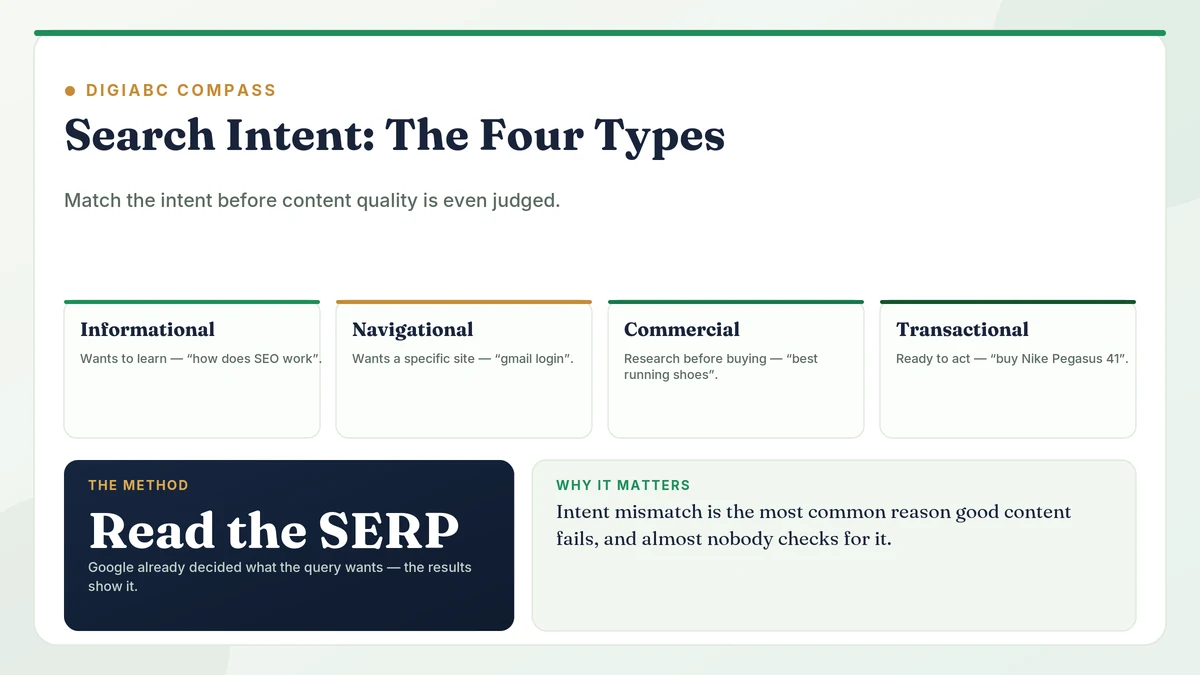
Search intent is the goal behind a search query, the reason someone typed it. The four main types are informational (learning something), navigational (finding a specific site), commercial (researching before a purchase), and transactional (ready to buy or act). Matching the intent decides whether a page can rank at all.
The four types of search intent
Informational searches want to learn. “How does SEO work,” “what is schema markup.” These want a clear explanation or guide. Navigational searches want a specific place: “gmail login,” “DigiABC Compass.” The searcher already knows where they are going.
Commercial searches are research before buying: “best running shoes,” “Rank Math vs Yoast.” These want comparisons and reviews. Transactional searches are ready to act: “buy Nike Pegasus 41,” “hire SEO consultant.” These want a product, a checkout, or a contact form.
How to spot the intent of a keyword
Do not guess. Search the term and read the first page. Google has already decided what that query wants, and the results show it. If the top ten are all how-to guides, the intent is informational. If they are product pages, it is transactional. If they are listicles comparing options, it is commercial.
This single habit, reading the live results before writing, prevents most intent mistakes. The work is covered further in our keyword research guide.
How to match content to intent
Once you know the intent, give Google the matching page type. Informational gets a thorough guide. Commercial gets an honest comparison. Transactional gets a clean product or service page with an obvious next step. A product page aimed at an informational query, or a thin blog post aimed at a buying query, both lose.
One opinion: intent mismatch is the most common reason good content fails, and almost nobody checks for it. Read the results first, every time.
Why intent decides whether you rank at all
Search intent is the single biggest reason a well-optimized page fails to rank. For each query Google has already decided what kind of page satisfies the searcher, and it fills the results with that page type. If your page is the wrong type, no amount of keyword optimization moves it, because it answers a different question than the one being asked. Matching intent is a prerequisite, not a finishing touch.
Read the live SERP to confirm intent
The fastest way to know a keyword’s intent is to search it and study what already ranks. The results are Google showing you, in public, the format it rewards. Note the dominant page type (guide, category, product, tool, or video) and any SERP features: a shopping carousel signals commercial intent, a map pack signals local, an answer box signals informational. Build the same type of page, only better. If the top ten are all listicles and yours is a product page, that mismatch is your answer.
Intent mapped to page type
Informational queries want guides, explainers, and how-tos. Navigational queries want a specific brand or page and rarely need new content. Commercial queries (“best”, “vs”, “review”) want comparisons and roundups. Transactional queries (“buy”, “price”, “near me”) want product, category, or local pages. Map every target keyword to one of these before you write a word.
Mismatches that quietly cost traffic
Common failures: targeting a “best [product]” keyword with a single product page, chasing a transactional term with a blog post, or writing a 3,000-word guide for a query the SERP answers in two sentences. Each wastes effort because the page can never match what Google is rewarding.
FAQ
Can one keyword have more than one intent?
Yes. Some queries are mixed, and Google often shows a blend of page types for them. When the results are mixed, the safest move is to match the dominant type while covering the others briefly.
How does search intent affect AI Overviews?
AI answers lean heavily on informational intent, pulling clear explanations and definitions. Structuring informational pages with direct, quotable answers improves the odds of being the source they cite.
Written by Kavinder Singh. Last updated: August 3, 2026.