What Is E-E-A-T? Experience, Expertise, Authority & Trust Explained
E-E-A-T stands for Experience, Expertise, Authoritativeness, and Trust. It is a framework used in Google’s Search Quality Rater Guidelines to help evaluate the quality and credibility of search results. E-E-A-T is not a single Google ranking score.
For a personal site that competes on credibility rather than budget, this is the whole game
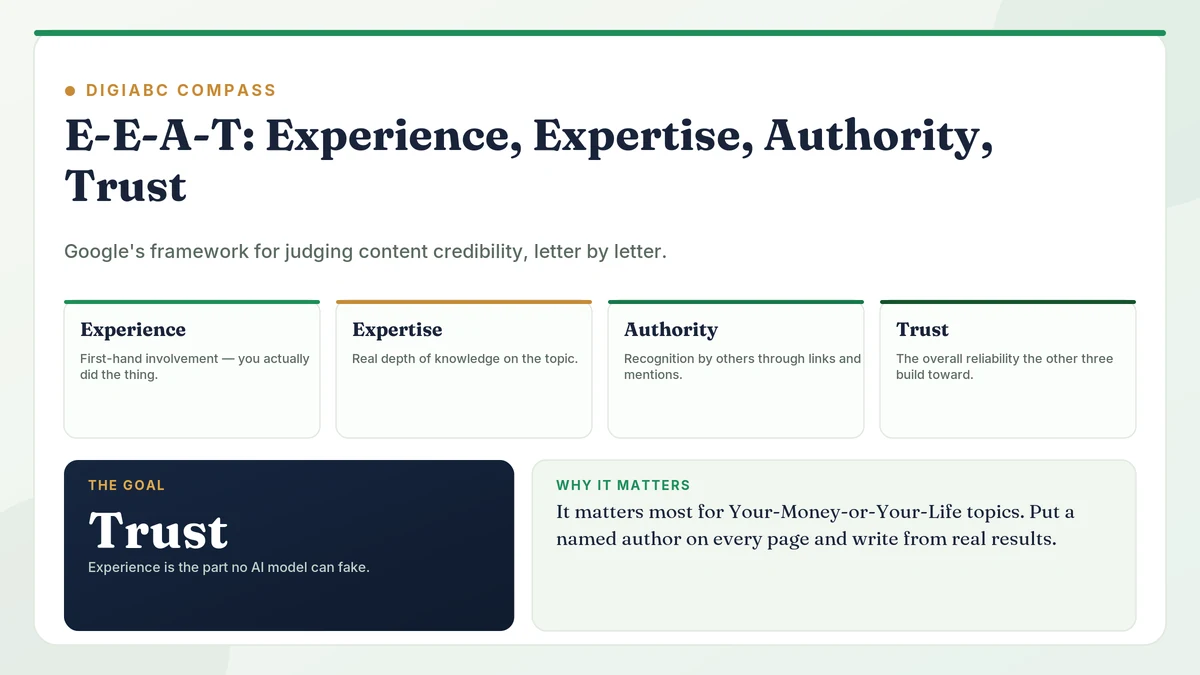
E-E-A-T stands for Experience, Expertise, Authoritativeness, and Trust. It is a framework from Google’s quality guidelines for judging content credibility. Experience is first-hand involvement, expertise is real knowledge, authoritativeness is recognition by others, and trust is the overall reliability the other three build toward.
What each letter means
Experience is the newest and most underused. It asks whether the writer has actually done the thing: travelled the place, used the product, run the campaign. Expertise is depth of knowledge. Authoritativeness is whether others, through links, mentions, and reputation, treat you as a source. Trust is the sum: is this content and this site reliable.
How to show E-E-A-T on your site
Put a real, named author on every page, with a bio that states genuine credentials. Write from first-hand experience and say so, with specific examples, real numbers, and the things that failed, not generic advice. Earn links and mentions from sites in your field. Keep the basics of trust in place: HTTPS, clear contact details, accurate information, and honest claims.
This is why this site puts one name on everything and writes only what has been tested. It also leans on strong content marketing and the authority signals covered in the SEO guide.
Why experience is the part that is hard to fake
Anyone can recombine existing expertise, and AI tools now do it instantly. What no model can supply is your case results, your screenshots, your failed experiments. As machine-made content floods the web, first-hand experience becomes the scarce signal, and the one Google and readers both reward.
One opinion: most sites obsess over expertise and ignore experience, which is backwards. The market is full of correct, generic advice. It is short on people showing what actually happened when they did the work.
E-E-A-T is a framework, not a ranking score
An important clarification: E-E-A-T is not a number Google assigns to your page. It comes from Google’s Search Quality Rater Guidelines, the instructions for the human raters who evaluate search quality. Their ratings help train and validate Google’s systems but do not directly score your site. So “improving E-E-A-T” means strengthening the real-world signals those systems use as proxies for experience, expertise, authoritativeness, and trust. Treat it as a direction, not a dial.
Where E-E-A-T matters most
It carries the most weight on “Your Money or Your Life” (YMYL) topics such as health, finance, legal, and safety, where bad information can cause real harm. For a travel or hobby blog the bar is lower, but trust still matters everywhere.
Concrete signals for each pillar
Experience: first-hand detail, original photos, “I tested, visited, or used this.” Expertise: author bios with credentials, accurate depth, correct terminology. Authoritativeness: citations from and links earned by recognized sources, plus a consistent topic focus. Trust: HTTPS, clear contact and about pages, transparent sourcing, real reviews, and no deceptive design. Trust sits at the centre of the model; the other three feed it.
A practical checklist
Add a real author byline and bio to every post; show first-hand experience with original media; cite primary sources; keep an up-to-date About and Contact page; and improve or remove thin, unsourced pages that drag down sitewide trust.
FAQ
Is E-E-A-T a ranking factor?
Not a single direct one. It is a framework describing what Google’s systems collectively try to reward. You cannot optimise an E-E-A-T number, but you can build the real signals, named authors, first-hand experience, and earned authority, that those systems detect.
Does E-E-A-T matter more for some topics?
Yes. It matters most for “Your Money or Your Life” topics like health, finance, and safety, where wrong information can cause real harm. Google holds those pages to a higher credibility bar.
Written by Kavinder Singh. Last updated: August 3, 2026.