How Reviews Rank a Local Business: Velocity, Specificity, and Responses (2026)
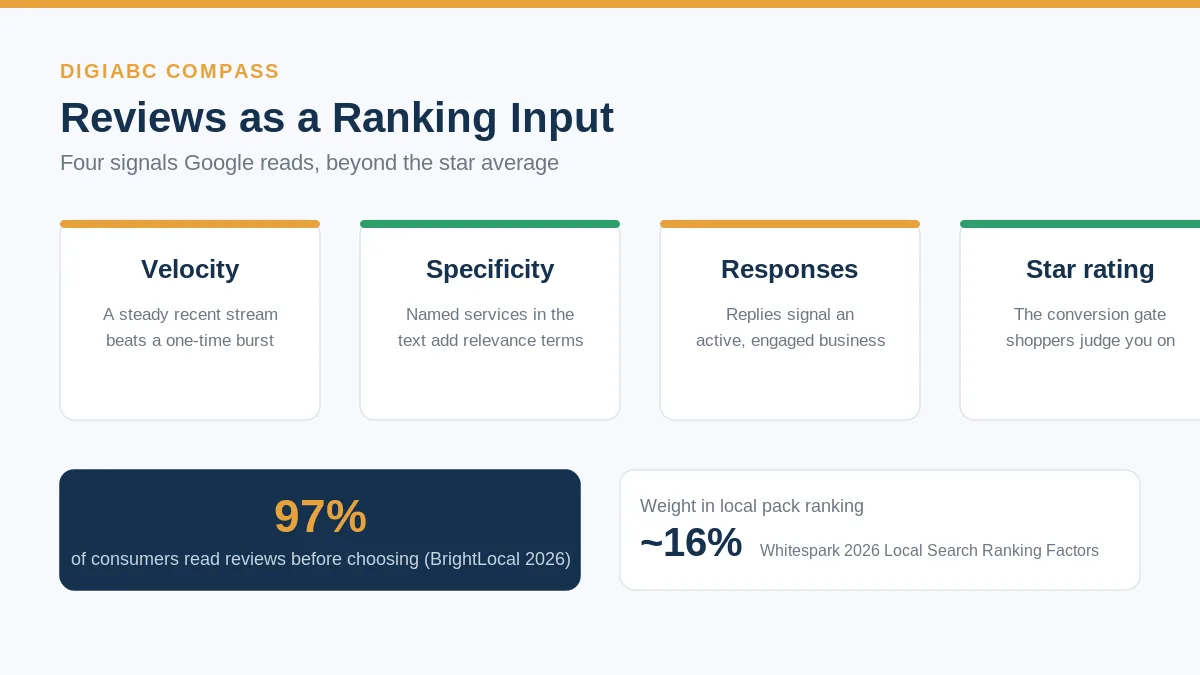
Reviews are the rare local SEO factor that works on both sides of the funnel at the same time. They help decide whether you show up, and separately, whether the person who sees you picks up the phone. BrightLocal’s 2026 Local Consumer Review Survey found 97% of consumers read reviews when choosing a business, and 41% now say they always do, up sharply from 29% a year earlier.
That dual role is why reviews are worth real effort. It is also why the lazy version, buying a batch or begging for five stars, backfires. Here is what actually moves the needle.
What role do reviews play in local SEO?
Reviews are both a ranking signal and a conversion signal. Google reads review quantity, velocity, content, and your responses as evidence of prominence and relevance, while shoppers read the same reviews to decide whether to trust you. Whitespark’s 2026 survey weights review signals at roughly 16% of local pack ranking.
Sixteen percent is not the biggest bucket, but it sits behind the Google Business Profile and on-page signals, ahead of links and citations. More importantly, reviews are one of the few factors you can actively grow without touching code. For where reviews sit among the other factors, the local SEO guide lays out the full ranking model.
Velocity beats volume
Review velocity is the rate at which you earn new reviews over time. A steady, recent stream signals an active, trusted business. A large burst followed by silence signals the opposite, and can look manipulated. Google reads the pattern, not just the total count.
Here is the mistake. An owner runs one review push, collects forty reviews in a week, and then never asks again. Three years later that profile reads as stale next to a competitor who quietly adds two or three reviews a month, every month. The competitor has fewer total reviews and a stronger signal.
The fix is to build asking into your normal workflow rather than running it as a campaign. Send the request at the moment the customer is happiest, right after the job is done and they have said thanks. A short, direct link to your Google review form removes the friction. Aim for a consistent monthly trickle you can sustain, not a spike you cannot repeat.
The words in a review matter as much as the stars
Review specificity is the presence of concrete service and location terms inside the review text. When a customer names the actual job, like “kitchen remodel” or “AC repair,” that phrase becomes a relevance signal tying your business to that exact search, working separately from the star rating.
This is the part most owners never think about. A review that says “great service, highly recommend” helps your star average and nothing else. A review that says “they did our kitchen remodel in Riverside and finished on schedule” hands Google two relevance terms and a location, attached to a real customer voice.
You cannot script reviews, and you should not try. What you can do is prompt gently. When you send the request, a line like “it would help us a lot if you mention which service we did for you” nudges customers toward specificity without putting words in their mouth. Most people are happy to oblige when asked plainly.
Responding to reviews is non-negotiable, especially the bad ones
A review response is your public reply to a customer’s review. Responding signals to Google that the business is active and engaged, and it signals to readers that someone is paying attention. An unanswered negative review reads as nobody minding the front door.
Respond to the negative ones first, and do not get defensive. A calm, specific reply that acknowledges the issue and offers to make it right does more for the next reader than the original complaint did against you. People do not expect a perfect record. They expect a business that handles problems like adults.
Respond to the positive ones too, briefly. A short thank-you that names the service keeps the relevance signal alive and shows the profile is tended. Set a habit: check and respond at least weekly. This is not a campaign you run for a quarter, it is a standing part of running the business.
What never to do with reviews
Review manipulation includes buying reviews, posting fake ones, gating out negative feedback, and marking up self-reported ratings as schema. All of these carry real penalty risk and undermine the trust that makes reviews valuable in the first place.
Two traps catch otherwise honest businesses. The first is review gating, where you funnel happy customers to Google and unhappy ones to a private form. Google’s guidelines prohibit it, and it is detectable. The second is faking aggregateRating schema on your own site. Review schema is meant for sites reviewing other businesses, not for marking up your own star rating. If you have three reviews on your site and two hundred on Google, the schema reflects the three, and anything else is a manual action risk. The correct schema setup is covered in the LocalBusiness schema guide.
Earn reviews honestly and the rest takes care of itself. The shortcut is the slow path here, because recovering from a penalty costs far more than the reviews were ever worth.
A simple review system you can actually keep
Pick the moment: right after a successful job. Use one channel: a direct link by text or email. Add one nudge: ask them to mention the service. Respond weekly to everything, negative first. Track the monthly count, not the lifetime total, so you are managing velocity rather than vanity.
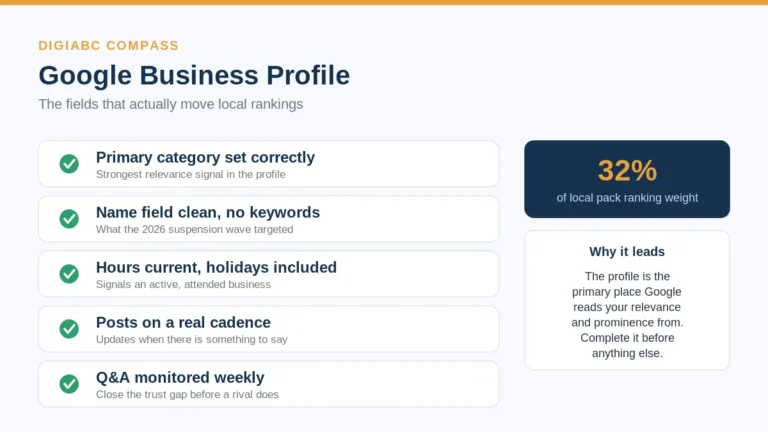
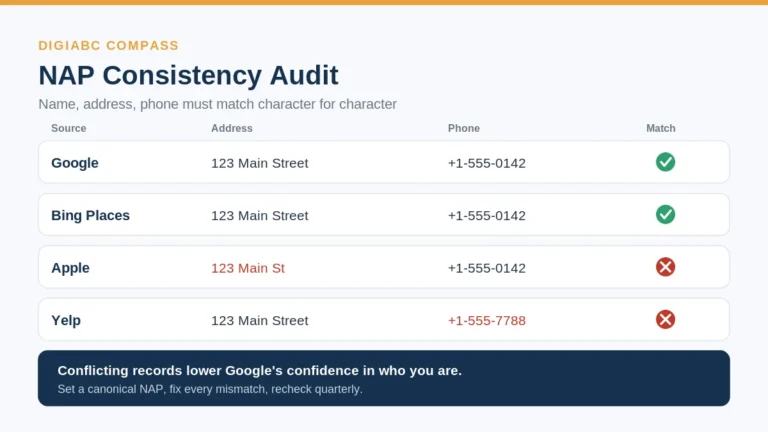
That system runs on a few minutes a week and compounds for years. While you are setting it up, make sure the profile those reviews land on is fully optimized, the steps are in the Google Business Profile guide, and that your name, address, and phone are consistent everywhere so the trust those reviews build is not undercut by conflicting data, which the NAP and citations guide covers.
Frequently asked questions
How many Google reviews do I need to rank well?
There is no fixed number. A steady stream of recent reviews matters more than a high lifetime total. A business adding a few genuine reviews a month often outperforms one with more reviews that all arrived years ago.
Should I respond to every review?
Yes, ideally. Respond to negative reviews first and without defensiveness, and keep positive responses short. Consistent responses signal an active business to both Google and the people reading.
Is it against the rules to ask customers for reviews?
No. Asking is allowed and encouraged. What is not allowed is gating, where you steer happy customers to public reviews and unhappy ones to a private channel. Ask everyone the same way.
Can I put my Google star rating on my website with schema?
Only if it reflects real reviews collected on your own site, and Google’s guidance restricts self-serving review schema. Marking up your Google rating as if it lived on your site is a manual action risk. See the schema guide for the correct approach.
Written by Kavinder Singh (Kavi), digital marketing strategist at DigiABC Compass.