Char Dham Yatra: A Practical Travel Guide
The Char Dham is the four-shrine Himalayan pilgrimage that defines a summer in Uttarakhand. It is also a logistics challenge: four high temples, far apart, on slow mountain roads, with a fixed season and rules that catch first-timers out. A little planning is the difference between a calm yatra and a stressful one.
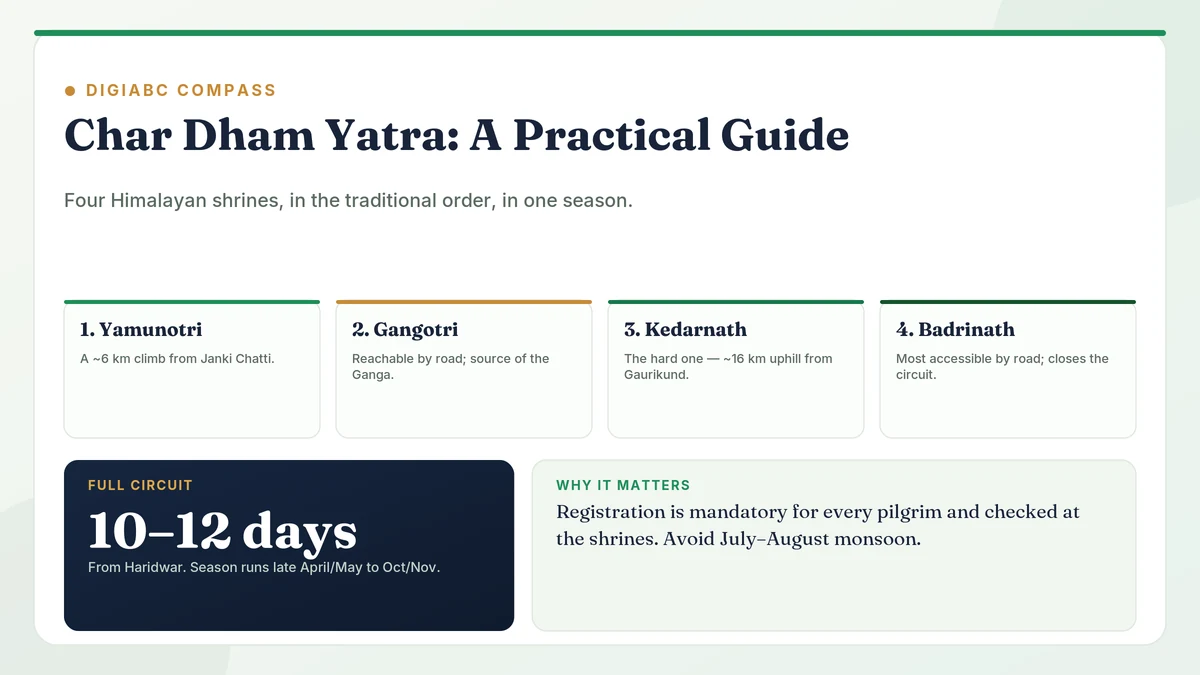
The Char Dham Yatra is a pilgrimage to four shrines in Uttarakhand: Yamunotri, Gangotri, Kedarnath, and Badrinath, visited in that traditional order. The season runs from around late April or May to October or November, every pilgrim must register in advance, and the full circuit usually takes ten to twelve days from Haridwar.
The four shrines and the order
The traditional sequence is Yamunotri first, then Gangotri, then Kedarnath, and Badrinath last. Yamunotri and Gangotri honour the source rivers Yamuna and Ganga. Kedarnath is the high Shiva shrine that the 2013 floods made famous. Badrinath, the most accessible by road, closes the circuit.
Most people start from Haridwar or Rishikesh and loop through in that order, since it follows the geography as well as the tradition.
Registration is mandatory
Uttarakhand requires every Char Dham pilgrim to register before starting. You can do it online through the state tourism registration portal or in person at centres in Haridwar, Rishikesh, and along the route. Carry the registration and a photo ID, because they are checked at the shrines. Skipping this step is the most common reason people get turned back.
The treks, especially Kedarnath
Two of the four need walking. Yamunotri is a climb of about six kilometres from Janki Chatti. Kedarnath is the hard one: roughly sixteen kilometres uphill from Gaurikund, on foot, by pony, or by booked helicopter from Phata or Guptkashi. Gangotri and Badrinath are reachable by road. Plan the Kedarnath day carefully, since it is the most demanding part of the circuit.
When to go, and when not to
The clear windows are May to June before the rains, and September to October after them. Avoid July and August. The monsoon brings real landslide risk in these valleys, and the high routes can close with little warning. Even in season, pack warm clothes, because the shrines sit high and the nights are cold.
FAQ
When does the Char Dham Yatra open and close?
The shrines open around late April or May, near Akshaya Tritiya, and close around October or November, near Diwali. Exact dates are announced each year and vary by shrine.
Is registration compulsory for the Char Dham?
Yes. Uttarakhand makes registration mandatory for all pilgrims, online or at designated centres. Carry the registration and photo ID, as they are verified along the route.
How long does the full Char Dham Yatra take?
Usually ten to twelve days from Haridwar, because the four shrines are far apart on slow roads and Kedarnath adds a full trekking day. Helicopter packages can shorten it.
Written by Kavinder Singh. Last updated: August 3, 2026.