Backlink Analysis: Steal Your Competitor’s Link Map
Building links from a blank page is guesswork. You are asking “who might link to me?” with no data behind the question.
Backlink analysis flips it. Instead of guessing, you look at exactly who already links to the sites beating you — and go get those same links. It is the difference between a cold pitch and a warm one.
Read a link profile before you copy it
Before chasing anyone’s links, judge whether the profile is worth copying. A rival ranking on spam will steer you into a penalty, not a win.
Four things tell you most of the story. Referring domains — how many unique sites link them, which matters far more than raw link count. Topical relevance — are the linking sites in their field or random? Anchor text — a natural spread of branded and descriptive anchors, or an obvious over-optimized pattern? And the trend — is the profile growing steadily or did it spike overnight, which usually means bought links.
A profile that grew slowly, from relevant sites, with varied anchors, is a profile worth learning from. One that spiked with exact-match anchors from unrelated blogs is one to avoid.
How to run a link gap analysis
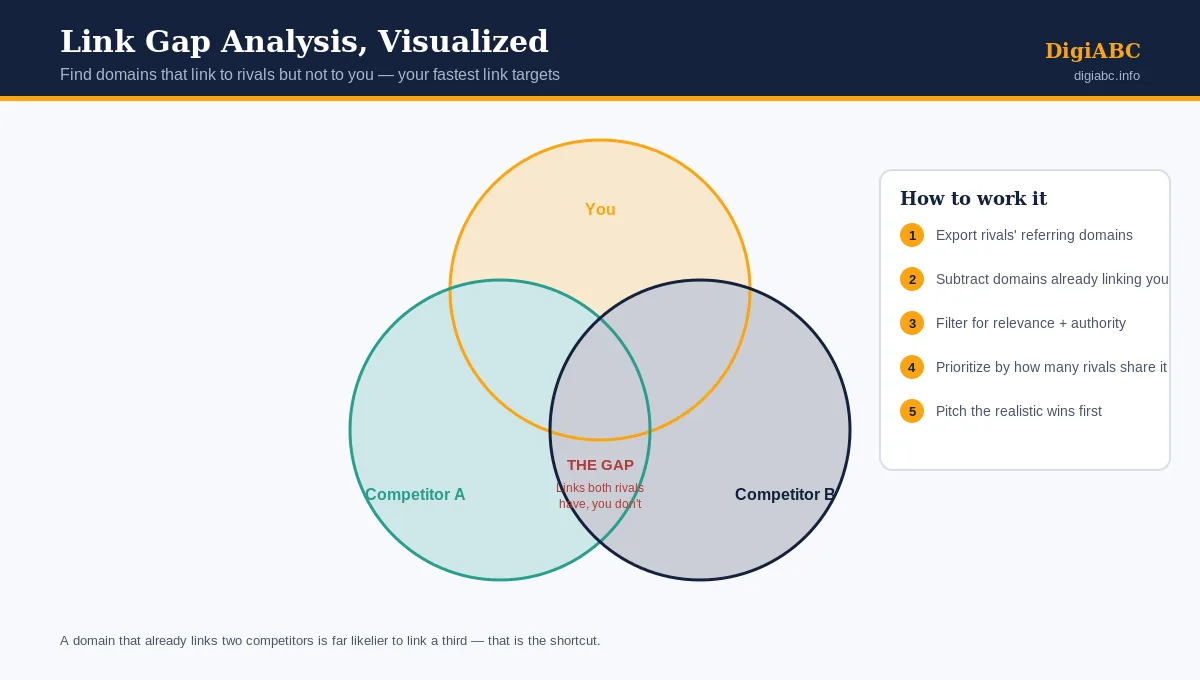
This is the workflow that turns analysis into an actual outreach list. The graphic above is the shape of it; here are the steps.
| Step | What you do | Why |
|---|---|---|
| 1. Pick 2–3 true competitors | Sites ranking for your target keywords, not just big brands | Their links are realistic for you to earn |
| 2. Export their referring domains | Pull the full list from your backlink tool | This is the raw pool of targets |
| 3. Subtract domains already linking you | Remove overlaps with your own profile | Leaves only the gap |
| 4. Filter for relevance & authority | Drop the junk and the irrelevant | Protects your profile quality |
| 5. Sort by how many rivals share each | A domain linking all three ranks top | Highest likelihood to link you too |
The domains that link all of your competitors are gold. A site that already references three players in your space clearly covers the topic and is the single likeliest place to earn your next link. Pitch those first.
Don’t skip the audit of your own profile
Analysis is not only about rivals. Run the same lens on yourself and you will find two things worth acting on.
Your best-earned links — study what content pulled them, then make more of that. And any genuinely toxic links from a past agency or a link scheme, which you can disavow if — and only if — you have a manual action or a real paid-link history. For most sites, Google already ignores the junk, so leave the disavow tool alone.
Key takeaways
- Backlink analysis replaces guesswork with a data-backed list of who to approach.
- Judge a profile by referring domains, relevance, anchor spread, and growth trend before copying it.
- The link gap — domains linking rivals but not you — is your fastest, warmest target list.
- Prioritize domains that link multiple competitors; they are likeliest to link you too.
Frequently asked questions
What tools do I need for backlink analysis?
A dedicated backlink index — Ahrefs, Semrush, or Moz — gives the fullest picture, and Google Search Console shows your own links for free. Free tools reveal a slice; paid tools reveal the competitor data that makes gap analysis possible.
How often should I run a backlink audit?
A full competitor gap analysis once a quarter is plenty for most sites. Check your own new and lost links monthly, so a sudden drop or a spammy influx does not go unnoticed.
How do I know if a backlink is toxic?
Look for irrelevance and manipulation: links from unrelated foreign-language sites, obvious link networks, or pages stuffed with exact-match anchors. One odd link is normal in any profile; a pattern of them is the warning sign.
Is this the same as link building?
It is the step before it. Analysis produces the target list; link building is the outreach and content work that turns that list into live links. Do the analysis first or you are building blind.
Prefer DigiABC in Google?
Add DigiABC Compass as a preferred source so our guides show up more often in your results.